
Have you ever considered the long-term reliability of circuit boards in electronics? Failures can lead to downtime, product recalls, and reputation damage. Traditional product development often involves building and testing prototypes—a process that can be costly and time-consuming. Our client faced this challenge, seeking to validate the structural integrity of a circuit card assembly (CCA) design before committing to physical prototyping.
Finite Element Analysis (FEA) offers a powerful solution. It allows us to simulate and analyze component behavior under various conditions, reducing the need for extensive physical prototypes.
The Challenge: Limiting Prototype Iterations Through Simulation
Our client, a leading manufacturer of aerospace equipment, faced a design challenge with a new, high-density CCA for an advanced aircraft system. The primary objective was to ensure the prototype could withstand operational loads without failure.
Key Structural Analyses for CCAs
Objectives
| # | Objective | Success Criterion |
|---|---|---|
| 1 | Determine natural frequencies and mode shapes. | All frequencies > 2X dominant aircraft vibration bands (≤ 800 Hz) |
| 2 | Quantify RMS stresses and displacements under worst-case (launch) environment PSD. | Frame RMS 3σ stress margin of safety (MS) > 0 for based on yield strength. CCA displacement < allowable deflection limits (Steinberg) |
| 3 | Evaluate peak stresses from a terminal-peak sawtooth shock worst-case (Qualification) condition. | Peak stress < allowable (0.8 × yield) MOS > 0.00 |
| 4 | Verify bolted‑joint performance (clamp force, bearing stress, loosening risk), and determine margins of safety (MOS). | Bearing stress < allowable (0.7 × bolt yield) Preload retained within ±10 %. MOS > 0.00 |
| 5 | Predict solder‑joint fatigue life under shock and vibration environments. | Predicted Cumulative Damage Index (CDI) using Steinberg methods CDI < 0.25, for 4X life based on 20 x 106 cycles‑to‑failure. |
Typical conservative assumptions
Our Solution: Predictive Analysis for Confident Design Validation
Understanding critical operating conditions, and gathering necessary data are essential for delivering accurate results. This includes CAD models, material properties, and environmental specifications.
FE Model
For effective FEA, the CAD geometry is typically simplified where possible to reduce computational burden while preserving critical features. Connections, like fasteners and connectors, are modeled as rigid or spring elements.
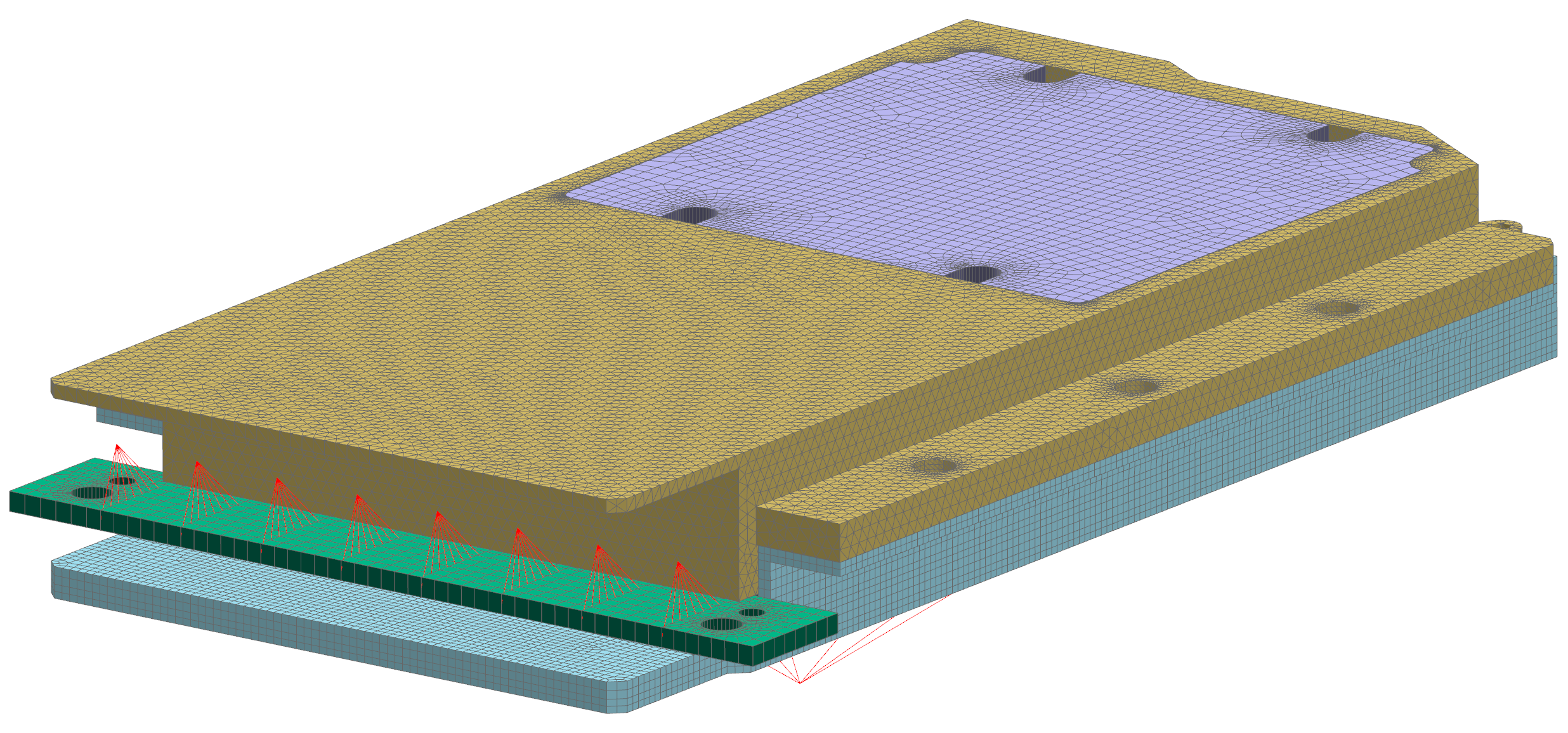
Operational Loads
For effective FEA, the CAD geometry is typically simplified where possible to reduce computational burden while preserving critical features. Connections, like fasteners and connectors, are modeled as rigid or spring elements.
| Analysis | Definition | Application |
|---|---|---|
| Modal | No external loads; only the mounting constraints. | Determines natural frequencies. |
| Random Vibration | Endurance profile PSD: 10 Hz – 2000 Hz, 0.04 – 0.06 g²/Hz. Applied as a base‑excitation at CCA mounting points. | Base‑excitation at bracket nodes (spectral analysis). |
| Shock | Terminal-peak sawtooth, 40 g, 11 ms duration, board-normal axis. | Transient dynamics (explicit integration). |
| Bolted Joint | Each M3×0.5 mm SS bolt pretension set to 2.5 N·m torque. | Evaluates clamp force variation and bearing stress. |
| Frequency (Hz) | Endurance PSD (g2/Hz) |
|---|---|
| 10 | 0.04 |
| 80 | 0.04 |
| 300 | 0.25 |
| 1000 | 0.25 |
| 2000 | 0.06 |
| gRMS = 17.9 | |
| Duration = 1 hour |
Launch – Endurance Profile PSD
Material Properties
Material properties for the PCB, components, fasteners, and adhesives were carefully defined based on manufacturer data and previous testing.
| Part | Material | Elastic Modulus (E) | Density (ρ) | Poisson’s Ratio (μ) | Yield Strength (σY) | Ultimate Strength (σU) |
|---|---|---|---|---|---|---|
| PCB Substrate | FR-4 (epoxy-glass) | 3,000 ksi | 0.067 lb/in3 | 0.13 | — | 50 ksi |
| Copper Planes | Cu | 16,000 ksi | 0.323 lb/in3 | 0.34 | 4.8 ksi | 30 ksi |
| Aluminum Frames | Al-6061-T6 | 10,011 ksi | 0.098 lb/in3 | 0.33 | 35 ksi | 42 ksi |
| SS Fasteners (NAS1352) | A286 (AMS5731L) | 29,000 ksi | 0.286 lb/in3 | 0.30 | 85 ksi | 130 ksi |
| SS Thread Inserts | CRES 304 | 28,000 ksi | 0.289 lb/in3 | 0.29 | 31 ksi | 73 ksi |
PCB Effective Mechanical Properties
| Composite Density (lb/in3) | Composite Elastic Modulus (ksi) | Composite Poisson Ratio (μ) |
|---|---|---|
| 0.0943 | 5,213 | 0.27 |
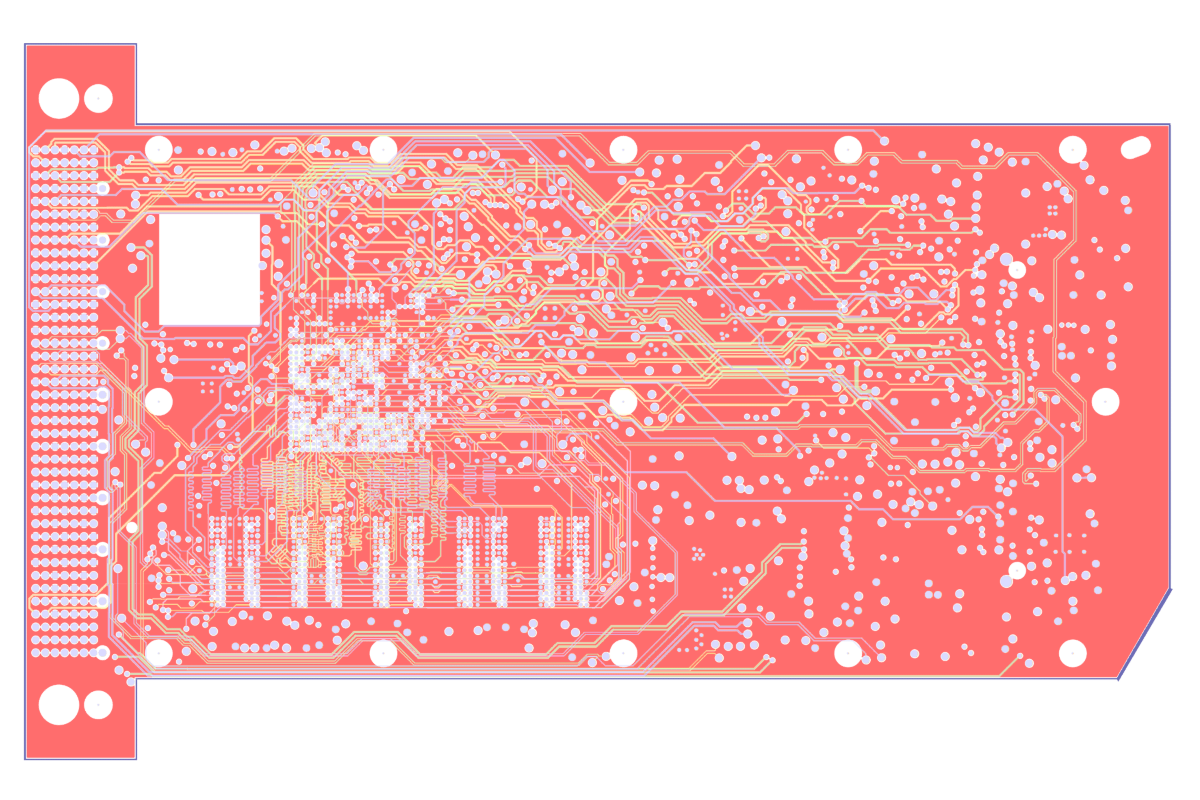
PCB Traces
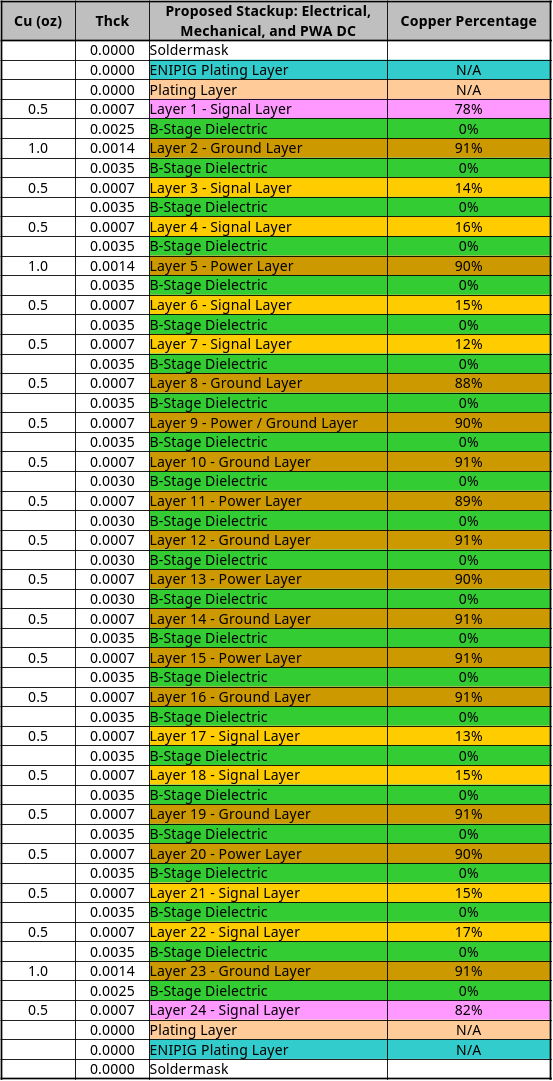
PCB Layer Stack-Up
The total weight of the electrical components was considered to be 0.50 lb. This weight was modeled as a non-structural mass evenly distributed across the entire PCB.
Boundary Conditions
Simply supported at mounting points – Fixed translation degrees of freedom (DOF).
Results and Impact: Validating CCA Design
The analyses provided valuable insights into the CCA’s structural integrity.
Modal Analysis
The first bending mode was at 1130.3 Hz, which sat comfortably above the defined 2X aircraft dominant frequency of 800 Hz, mitigating resonance risks.
Random Vibration Analysis
Results indicated that certain components experienced higher stress levels than initially anticipated. Areas around the unsupported center areas of the PCB were vulnerable. RMS max. displacement ≈ 0.006 in. @ PCB, and ≈ 0.011 in. @ Secondary Frame.
Max. RMS 3σ von Mises stress in secondary frame ≈ 51.9 ksi.
Shock Response Analysis
The shock response analysis revealed minimal displacements. Max ≈ 0.001 in.
Peak Von Mises stress ≈ 55.7 lb.
Bolted Joint Analysis
Current fasteners meet performance criteria. MOS > 0
| Failure Mode | MOS |
|---|---|
| Joint Separation | 0.34 |
| Fastener Thread Shear | 7.43 |
| Insert Inner Thread Shear | 6.64 |
| Insert Outer Thread Shear | 5.62 |
| Parent Material Thread Shear | 2.11 |
| Fastener Strength (Tension + Shear) (Ult.) | 1.07 |
| Joint Bearing (FR4) | 4.01 |
| Joint Tension (hoop stress) (FR4) | 3.86 |
| Shear Tear-Out (FR4) | 5.25 |
| Pull-Through Shear (FR4) | 12.76 |
Solder Joint Reliability Analysis
Max. desired PCB displacement for an expected component life of 20 million stress reversals in random vibration and shock operational environments.
* Adapted from: Steinberg, D. S. (1988). Vibration analysis for electronic equipment (2nd ed.). John Wiley & Sons.
Cumulative damage index (CDI) is based on deflection using Miner’s cumulative damage ratio.
The worst case predicted CDI exceeded fatigue life requirement.
Max. CDI ≈ 0.22 was predicted for the worst case J1 component, which is below the requirement limit of 0.25.
Critical Components
| Ref. Designator | Component Type | CDI |
|---|---|---|
| U5 | SMT | 0.11 |
| U30 | BGA | 0.12 |
| U41 | FP | 0.10 |
| J1 | FP | 0.22 |
Results Summary
The analysis revealed a potential structural weakness in the component’s secondary side cover. Peak 3σ stresses (55.7 ksi) exceeded the material’s ultimate strength (42 ksi), indicating a need for design adjustments, such as incorporating proper blend radii.
CCA Displacement (0.0056 in) remained within allowable deflection limits for a 20 million cycle component life in leaded and leadless components, with a minimum cumulative damage index below 0.25 for all critical components. 20 million cycles is roughly equivalent to 4.9 hours of vibration at the CCA natural frequency and critical operational load level. The predicted displacement remained below sway space limits, and a safety margin of 0.34 was projected for the most critical bolted joint under peak board-normal vibration.
Overall, the CCA demonstrated strong performance against structural and reliability requirements, achieving acceptable margins across key metrics; however, targeted design adjustments to the secondary side cover are necessary to ensure long-term structural integrity and consistent component reliability.
Expertise in Action
The successful outcome of this engagement demonstrates our ability to provide end-to-end FEA solutions specifically tailored to the unique mechanical design challenges of each product.
Our team’s expertise in mechanical analysis provided a critical layer of risk mitigation for this project, not only ensuring the structural integrity of the CCA but also accelerating the design and qualification process.
Key Benefits of Using FEA
We offer a comprehensive range of services, from initial design concept evaluation to detailed analysis and validation. We utilize advanced simulation tools and methodologies to provide accurate, reliable results that empower our clients to make informed decisions and optimize product performance.
Ready to enhance your product development process and mitigate risk?
Contact us today to discuss your specific needs and discover how our FEA consulting services can drive innovation and deliver tangible business value.
Let us help you navigate the complexities of advanced simulation and unlock the full potential of your designs.

Develop Better Designs: Adjustable Fixture
Adjustable fixture for RF Antenna development.
Machine Retrofit: Enable Continuous Improvement
Machine retrofit enables continuous improvement.

Resilient Electronics: Structural Analysis of a Circuit Card Assembly (CCA)
Enabling design optimization and accelerating the design process by validating structural integrity before committing to a physical prototype.