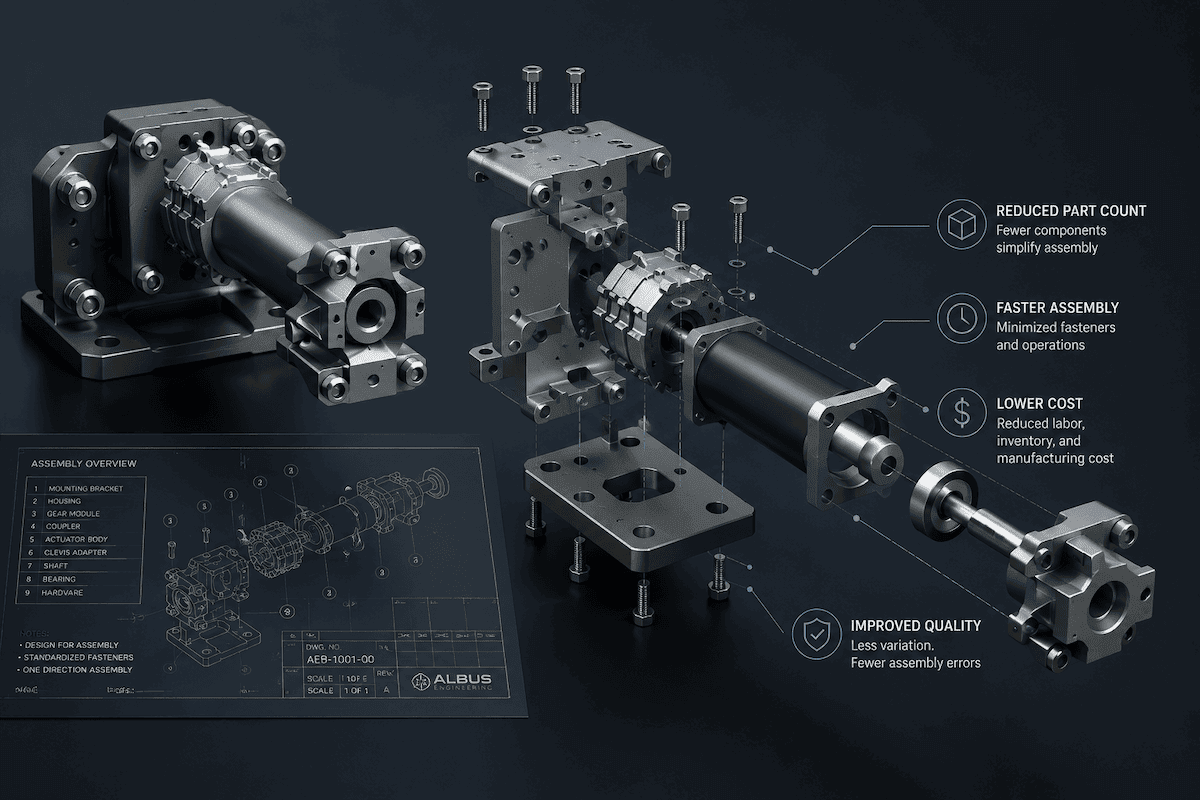
Design for Assembly: Reducing Manufacturing Costs Through Smarter Engineering
In manufacturing, even a well-designed product can become expensive and inefficient if it is difficult to assemble. This can raise production costs, and create avoidable quality issues during manufacturing.
Design for Assembly (DFA) is an engineering approach focused on simplifying how products are built. By reducing complexity early in the design process, engineers can improve manufacturing efficiency, and lower overall production costs.
Whether you’re developing industrial equipment, consumer products, fixtures, or mechanical systems, incorporating design for assembly principles can have a significant impact on long-term manufacturing performance.
What Is Design for Assembly?
Design for Assembly is the practice of designing products and components in ways that simplify assembly operations. The goal is to minimize the time, effort, tools, and complexity required to assemble a product while maintaining functionality, quality, and reliability.
DFA is closely related to Design for Manufacturing (DFM). While DFM focuses on how individual parts are fabricated, DFA focuses on how those parts fit together efficiently during production.
In many cases, the two disciplines work together:
- DFM improves manufacturability of components
- DFA improves efficiency of the final assembly process
When applied early in product development, DFA can help prevent costly manufacturing challenges before production begins.
Why Design for Assembly Matters
Assembly labor represents a significant portion of manufacturing cost for many products. Complex assemblies often require:
- additional labor hours
- more training
- specialized tools
- increased inspection requirements
- higher risk of assembly mistakes
Even small inefficiencies can become expensive when repeated across large production volumes.
Design for assembly helps manufacturers:
- reduce production time
- improve assembly consistency
- lower labor costs
- reduce rework and scrap
- simplify inventory management
- improve product serviceability
Simplified assemblies can also improve communication between engineering, fabrication, procurement, and production teams by reducing unnecessary complexity throughout the manufacturing process.
Common Design for Assembly Principles
While every product has unique requirements, several core DFA principles are widely used across mechanical design and manufacturing.
Reduce Part Count
Reducing the number of individual components is one of the most effective ways to simplify assembly.
Fewer parts often result in:
- fewer assembly steps
- reduced inventory complexity
- lower procurement costs
- shorter assembly times
- fewer potential failure points
In some cases, multiple brackets, spacers, or mounting components can be combined into a single manufactured part through machining, forming, or weldment design.
Minimize Fastener Variety
Using many different fastener types can slow assembly and increase the likelihood of errors.
Standardizing hardware where possible helps:
- simplify tooling requirements
- reduce assembly confusion
- improve purchasing efficiency
- streamline inventory management
Reducing the number of unique fasteners also helps improve consistency during assembly and maintenance.
Design for Simple Orientation and Handling
Components that can only be assembled in one orientation help reduce operator error and speed up production.
Features such as:
- alignment tabs
- locating pins
- chamfers
- asymmetric geometry
can help guide assembly and improve repeatability.
Designing components that are easy to grip, position, and install can also improve ergonomics and reduce assembly fatigue.
Improve Accessibility During Assembly
Assembly becomes more difficult when fasteners or components are difficult to reach.
Poor accessibility can:
- increase assembly time
- require specialized tools
- create maintenance challenges
- increase the risk of improper installation
Considering tool clearance and assembly access during design can significantly improve manufacturing efficiency and future serviceability.
Standardize Components
Using standardized materials and components where appropriate can reduce cost and simplify sourcing.
Standardization can improve:
- supplier flexibility
- inventory management
- replacement part availability
- manufacturing scalability
This is especially important for products intended for long-term production or field maintenance.
How DFA Reduces Manufacturing Costs
One of the primary goals of design for assembly is reducing overall production cost without compromising functionality or quality.
Simplified assemblies can reduce manufacturing expenses in several ways.
Reduced Assembly Labor
Fewer components and simpler assembly procedures reduce the amount of labor required per unit. Even small reductions in assembly time can create substantial cost savings over larger production runs.
Lower Error and Rework Rates
Complex assemblies increase the likelihood of:
- incorrect part installation
- missing hardware
- alignment issues
- inconsistent assembly quality
DFA helps minimize these risks by simplifying assembly procedures and reducing opportunities for error.
Faster Production Scaling
Products designed with efficient assembly processes are generally easier to scale during production increases. Simplified workflows can reduce training requirements and improve throughput consistency.
Reduced Inventory Complexity
Minimizing unique parts and hardware reduces inventory management challenges and simplifies procurement processes.
This can help manufacturers reduce overhead while improving supply chain flexibility.
Real-World Examples of DFA Improvements
In practice, small design changes can create major improvements in manufacturing efficiency.
Examples may include:
- replacing multiple brackets with a single bent sheet metal component
- reducing the number of fasteners required for assembly
- integrating locating features directly into parts
- redesigning assemblies for one-direction installation
- improving component access for assembly tools
These changes may appear minor individually, but they often have measurable impacts on labor time, assembly quality, and long-term manufacturing cost.
DFA During the Product Development Process
The earlier DFA considerations are introduced into product development, the more effective they become.
Waiting until production begins to identify assembly problems can lead to:
- redesign costs
- production delays
- tooling modifications
- increased manufacturing expenses
Collaborating early with:
- design engineers
- manufacturing teams
- machinists
- fabricators
- assembly personnel
can help identify potential assembly challenges before they become costly production issues.
Prototype reviews and assembly validation testing are also valuable for identifying areas where products can be simplified or optimized further.
Common DFA Mistakes
Even experienced engineering teams can encounter design decisions that unintentionally complicate assembly.
Some common issues include:
- excessive custom hardware
- unnecessary part complexity
- inaccessible fasteners
- tight tolerances where unnecessary
- assemblies requiring special tools
- designs with unclear assembly orientation
- insufficient consideration for maintenance access
Addressing these issues early can improve both production efficiency and long-term product reliability.
Final Thoughts
Design for Assembly is not simply about reducing parts or speeding up production. It is about making smarter engineering decisions that improve manufacturability, reduce operational friction, and support long-term production success.
Efficient assembly-focused design can help manufacturers reduce labor costs, improve quality, simplify production workflows, and scale more effectively.
By considering assembly requirements early in the engineering process, companies can avoid costly manufacturing challenges while creating products that are easier to build, maintain, and support over time.
Contact Albus Engineering to discuss your next project. From mechanical design and analysis to technical documentation, our team delivers precise and reliable support at every stage of development. Explore our services to learn more.
Share This Story, Choose Your Platform!
About the author : Albus Content Team